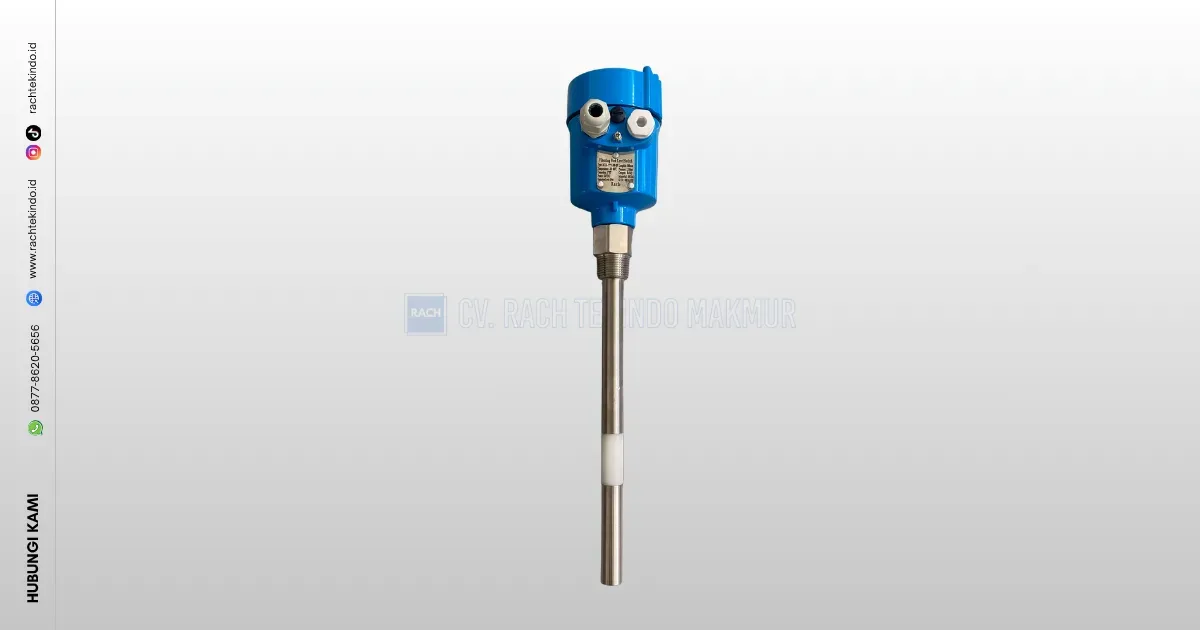
A Capacitance / Admittance Level Transmitter is a continuous level measurement instrument designed to accurately measure the level of liquids inside tanks, vessels, and storage silos. It operates by detecting changes in capacitance between the sensing probe and the tank wall, converting the measured value into a standard 4–20 mA output signal that can be integrated with PLC, DCS, or SCADA systems.
Unlike a Level Switch, which only provides an ON/OFF signal at a specific point, a Capacitance / Admittance Level Transmitter continuously monitors liquid level in real time. This makes it an ideal solution for process control, automatic level monitoring, inventory management, and industrial automation.
One of the main advantages of RF Admittance technology is its ability to compensate for probe coating or material build-up, ensuring stable and reliable measurement even in difficult process conditions. It is suitable for measuring water, oil, chemicals, acids, alkalis, and many other conductive or non-conductive process liquids.
With no moving mechanical parts, the transmitter offers excellent long-term reliability, low maintenance requirements, and high resistance to demanding process conditions including high pressure and elevated temperatures. It is widely used in oil & gas, chemical processing, water treatment, food & beverage, pharmaceutical, power generation, and many other industrial applications.
Selecting the correct Capacitance / Admittance Level Transmitter depends on several factors, including process media, operating pressure, temperature, probe length, and construction materials. When properly selected, it provides accurate, stable, and maintenance-free continuous level measurement for a wide variety of industrial processes.