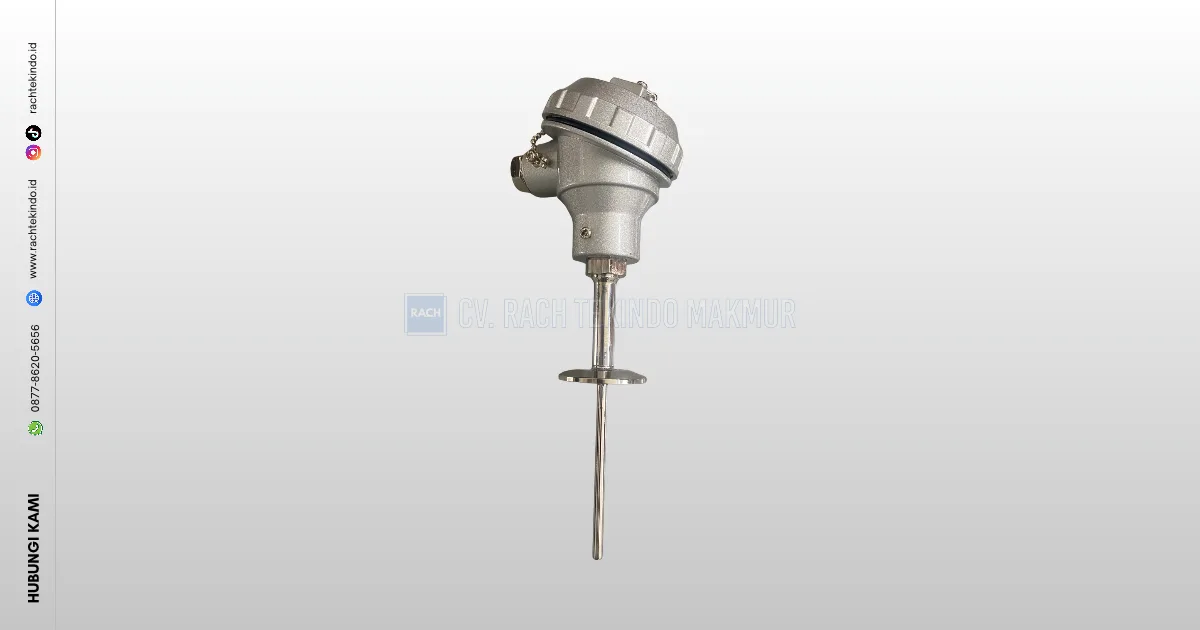
In industrial instrumentation systems, temperature measurement requires more than a sensor that can detect temperature changes. The measurement signal also needs to be transmitted to the control system so that it can be monitored and used for process control.
This is where a Temperature Transmitter plays an important role. One of the most widely used outputs is 4–20 mA, which has become a common standard in industrial instrumentation and control systems.
What Is a 4–20 mA Temperature Transmitter?
A temperature transmitter is a device that receives a signal from a temperature sensor and converts it into an output signal that can be transmitted to a control system.
Sensors such as RTD Pt100, Type K Thermocouple, and Thermistor generate different types of signals depending on their operating principles. The temperature transmitter processes these signals and converts them into a standardized output, including 4–20 mA.
This output allows temperature information to be transmitted from the measurement point to PLC, DCS, SCADA, or other monitoring equipment.
How Does the 4–20 mA Signal Represent Temperature?
A temperature transmitter normally associates the 4–20 mA output with a specific temperature range.
For example, a transmitter may be configured for a measurement range of 0°C to 100°C. In this configuration, 4 mA can represent 0°C while 20 mA represents 100°C.
When the measured temperature is somewhere between the minimum and maximum range, the output current will also fall between 4 and 20 mA. The control system reads this current value and converts it into the corresponding temperature according to the transmitter configuration.
This makes temperature measurement easier to integrate into an industrial control system.
Why Is 4–20 mA Widely Used?
The 4–20 mA signal has been widely used in industrial instrumentation for many years and can be found in devices such as pressure transmitters, flow transmitters, level transmitters, and temperature transmitters.
Using a standardized signal makes it easier to integrate different components within an instrumentation system. A temperature transmitter can be installed near the process area while its output signal is transmitted to a control panel or control room.
This is particularly useful when the distance between the measurement point and control system is relatively long.
Temperature Transmitters for PLC, DCS, and SCADA
In an industrial automation system, a temperature transmitter can act as the interface between the temperature sensor and the control system.
The transmitter's 4–20 mA output can be connected to an analog input on a PLC or another control device. The system can then display the temperature through an HMI, SCADA, or monitoring interface.
Temperature data can also be used as part of process control. Changes in temperature, for example, can be used to control heating, cooling, valves, heaters, or other equipment according to the system configuration.
Selecting the Right Temperature Transmitter
The temperature transmitter should be selected according to the sensor being used and the requirements of the control system. The transmitter input must be compatible with the RTD, thermocouple, or thermistor installed at the measurement point.
The temperature range and output type should also be considered. For certain applications, communication options such as HART or RS485 may be useful when additional information or digital communication is required.
The mounting configuration should also match the installation. Temperature transmitters are available in configurations such as head-mounted, rail-mounted, and field-mounted versions.
The Importance of Proper Configuration
A temperature transmitter does more than simply convert a sensor signal into a 4–20 mA output. The input type, measurement range, output, and mounting configuration should all be compatible with the complete measurement system.
If the transmitter range does not match the process requirements, the measurement resolution available to the control system may not be optimal. Therefore, the sensor characteristics and process conditions should be identified before selecting the transmitter.
Conclusion
A 4–20 mA Temperature Transmitter provides an important connection between temperature sensors and industrial control systems. Signals from RTD Pt100, thermocouples, and other temperature sensors can be processed into a standardized output that can be received by PLC, DCS, SCADA, and other monitoring systems.
With the right transmitter and configuration, temperature measurement can be integrated from the process area through to the control room.
CV. Rach Tekindo Makmur provides 4–20 mA Temperature Transmitters for integrating temperature sensors with PLC, DCS, SCADA, and industrial control systems. If you need a transmitter compatible with a specific sensor type, temperature range, or output requirement, contact us via WhatsApp at +62 877-8620-5656 to discuss your technical requirements and request a quotation based on the required configuration.